

January often arrives with a quiet kind of pressure. The holidays are over, routines return, and suddenly there is an unspoken expectation to feel motivated, focused, and ready to start fresh.
But for many people, January does not feel like a beginning. It feels like a pause. Or a letdown. Or a continuation of exhaustion that never quite resolved itself during the holidays.
If you are feeling low-energy, unmotivated, or emotionally worn down right now, you are not behind. You are responding honestly to what your body and mind have been carrying.
This January, instead of setting resolutions, it may be more supportive to set boundaries.
Why January Can Feel Heavier Than We Expect
The holidays often require more emotional labor than we realize. There are gatherings to attend, expectations to manage, finances to stretch, and emotions to navigate. Even joyful moments can be draining when they are layered on top of grief, family tension, or mental health struggles.
When January arrives, that emotional bill often comes due.
Add shorter days, colder weather, and the sudden shift back into work and responsibilities, and it makes sense that motivation feels scarce. For people living with depression or anxiety, January can intensify symptoms rather than relieve them.
Mental health does not reset on January 1st. Our nervous systems respond to rest, safety, and realistic expectations, not calendars.

The Problem With New Year’s Resolutions and Mental Health
New Year’s resolutions are often framed as hopeful. Exercise more. Be more productive. Fix what feels broken.
But resolutions tend to focus on outcomes without accounting for capacity. They ask what you should do differently without asking what you realistically have the energy to sustain.
For people who are already feeling burned out or overwhelmed, resolutions can quietly increase shame. When a resolution slips, it can reinforce the belief that you are failing or not trying hard enough.
In reality, many resolutions fail not because of a lack of discipline, but because they are built on pressure instead of support.
Resolutions vs Boundaries: A Different Way to Start the Year
Instead of asking how to improve yourself this January, boundaries ask a different question. What do you need to protect?
Resolutions are often about adding more effort. Boundaries are about reducing strain. They are not about giving up or lowering standards. They are about aligning expectations with reality.
Here is a simple way to think about the difference.
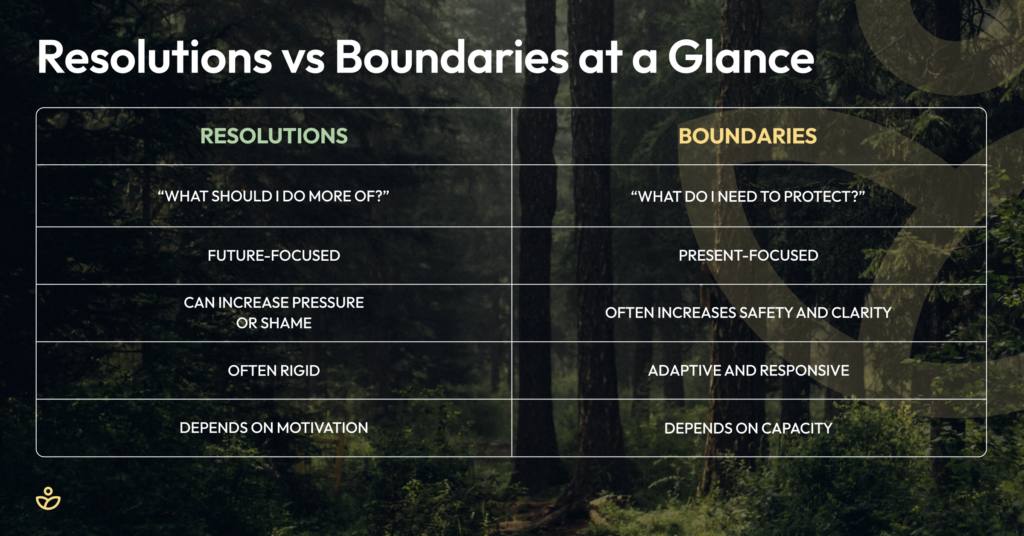
You might notice that boundaries do not require you to become someone new. They simply ask you to respond honestly to where you are right now.
Why Boundaries Support Mental Health
From a mental health perspective, boundaries help regulate stress, reduce resentment, and protect emotional energy. They create a sense of agency, which research consistently links to improved well-being.
Boundaries are not punishments or ultimatums. They are information. They tell you and others what helps you stay grounded and what pulls you toward overwhelm.
When boundaries are in place, people often report feeling less reactive, less depleted, and more emotionally steady.
Boundaries That Can Support Mental Health in January
Boundaries look different for everyone. There is no checklist to complete. Instead, think of them as gentle experiments.
Emotional Boundaries
- Letting yourself feel low without immediately trying to fix it
- Choosing not to engage in conversations that feel dismissive or invalidating
- Releasing the need to explain your emotions to everyone
Time and Energy Boundaries
- Saying no to commitments that feel draining rather than restorative
- Allowing productivity to be slower as you transition into the year
- Protecting rest without justifying it
Relationship Boundaries
- Taking space from relationships that feel demanding right now
- Allowing connections to be quieter for a season
- Asking for support instead of pushing through alone
Digital and Media Boundaries
- Limiting exposure to comparison-heavy social media
- Taking intentional breaks from constant news consumption
- Curating content that feels grounding rather than overwhelming
None of these boundaries are permanent. They are supports for this season.
What If You Skip Resolutions Entirely?
It is okay to skip resolutions.
January does not have to be a self-improvement project. It can be a time of recalibration. A month where stability matters more than progress.
For many people, mental health improves when pressure decreases. Choosing boundaries over resolutions can be a way of honoring your nervous system rather than pushing against it.
Rest is not avoidance. It is often preparation.
When Setting Boundaries Feels Hard
Even when boundaries are helpful, they are not always easy. Guilt, fear of disappointing others, and long-standing people-pleasing patterns can make boundaries feel uncomfortable or selfish.
This discomfort does not mean you are doing something wrong. It often means you are doing something new.
Support can be helpful here. Not because you are failing, but because boundaries are skills. Skills get easier with guidance, practice, and compassion.
Therapy as Support, Not Failure
Therapy is not about fixing what is broken. It is about creating space to understand yourself, strengthen boundaries, and build tools that support your mental health over time.
At Anew Therapy, we work with people who feel burned out, overwhelmed, or unsure how to move forward. We also have extensive experience working directly with insurance companies, so you do not have to navigate that process alone.
Support is not a last resort. It is a resource.
A Final Word
You do not need to transform yourself this January. You do not need to set lofty goals or prove anything about your worth.
You are allowed to start the year by listening. By setting boundaries that honor your capacity. By choosing care over pressure.
If you would like support as you navigate this season, Anew Therapy is here to help.Learn more or schedule a consultation at https://anewtherapyutah.com

Looking for the best full-service mental health clinic in Utah? Anew Therapy works with most insurance plans and supports you throughout your care. Schedule your free intake appointment today.
