

Does TMS help with anxiety? For those who haven’t found relief with traditional treatments, this is a critical question. The answer is promising. The FDA has cleared specific TMS systems to reduce anxiety symptoms in people with major depressive disorder, a condition often called anxious depression. Research strongly supports this, showing significant, lasting reductions in anxiety. While early studies also show potential for standalone anxiety disorders like GAD, TMS is not yet FDA-approved for these conditions on their own.
Anxiety is more than just worry; it’s a persistent and overwhelming feeling that can severely impact daily life. Globally, over 300 million people live with an anxiety disorder, yet many do not receive the help they need. Studies suggest a significant treatment gap, with up to 75% of those affected in America possibly going untreated.
This is where Transcranial Magnetic Stimulation (TMS) offers a new wave of hope. As a non-invasive treatment, it uses magnetic fields to stimulate brain cells, helping them function more effectively and offering a new path toward relief.
How TMS Works and What to Expect During Treatment
At Anew Therapy Utah, we are committed to offering innovative, evidence-based treatments like Transcranial Magnetic Stimulation (TMS). It’s a remarkable approach that works with your brain’s natural processes to help you find relief from anxiety.
The Science Behind TMS: Modulating Brain Activity
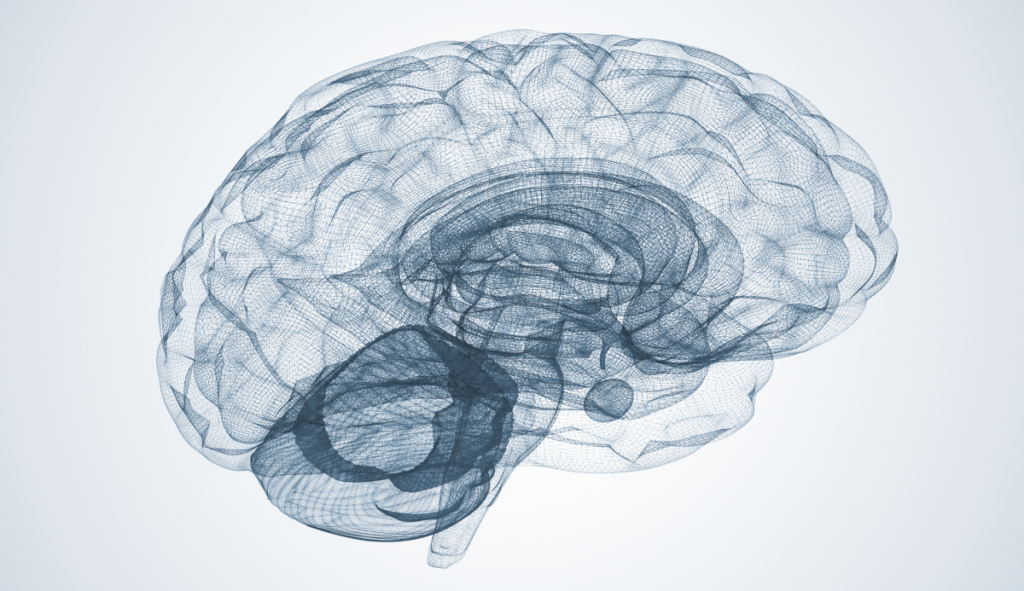
How does TMS work? In conditions like anxiety, communication between nerve cells in certain brain regions can become imbalanced. TMS is a non-invasive procedure that uses magnetic fields to gently adjust this brain activity. We place an electromagnetic coil near the scalp, typically over the dorsolateral prefrontal cortex (DLPFC), a key area for mood and emotional regulation.
The TMS device sends focused magnetic pulses (similar in strength to an MRI scan) through the skull. These pulses create tiny electrical currents in the targeted nerve cells. This gentle stimulation can either activate or quiet specific brain regions, helping to rebalance their activity. This process, known as neuroplasticity, encourages the brain to reorganize itself and form healthier connections. By fine-tuning the activity in the DLPFC and its communication with the brain’s fear center (the amygdala), TMS aims to calm anxious feelings and restore the brain’s natural rhythm. For a deeper look at how TMS alters brain activity, you can visit the Hopkins Medicine FAQ on TMS.
TMS Approaches Used at Anew Therapy Utah
The most common and well-researched form of TMS is Repetitive Transcranial Magnetic Stimulation (rTMS), which delivers repeated magnetic pulses over a set period. At Anew Therapy, we primarily use rTMS with a “figure-8” shaped coil, which allows us to target brain activity with high precision, reaching 2-3 centimeters below the scalp. We focus on evidence-based protocols to create a personalized treatment plan that targets the most relevant brain areas for your specific needs. For more general information on TMS, the Anxiety & Depression Association of America offers valuable insights.
What a Typical TMS Session for Anxiety Involves
TMS is a convenient outpatient procedure that requires no anesthesia, allowing you to resume your day immediately afterward. A typical session lasts between 30 and 60 minutes.
During a session, you will relax in a comfortable chair while a trained technician positions the coil on your head. When the treatment begins, you will hear a clicking sound and feel a tapping sensation on your scalp. Most patients find this tolerable, and we can adjust the settings for your comfort. You remain fully awake and alert throughout the session, and many patients use the time to read, listen to music, or simply relax. The National Institute of Mental Health (NIMH) provides more details on what to expect during a TMS treatment session.
So, Does TMS Help with Anxiety? A Look at the Evidence and Outlook
While TMS is well-established for major depression, its role in easing anxiety is rapidly growing, with new research continually highlighting its potential.
The Research: How Effectively Does TMS Help with Anxiety?
While TMS is not yet FDA-approved for all standalone anxiety disorders, it has gained FDA approval for anxious depression, which is when major depressive disorder co-occurs with significant anxiety. This is a major step, as anxious depression is often resistant to traditional treatments.
The scientific evidence is compelling:
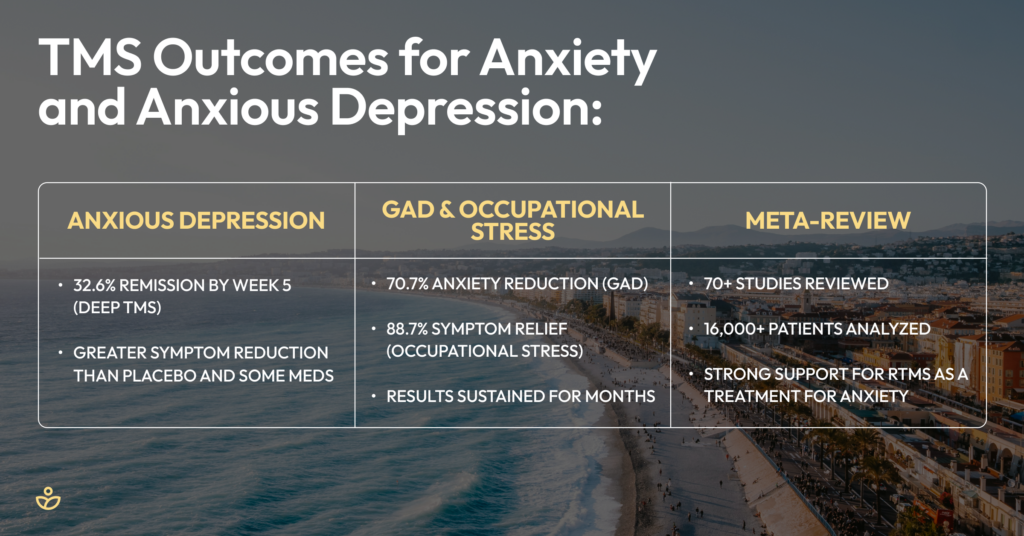
- For Anxious Depression: A large study on deep TMS found that it significantly reduced anxiety symptoms by the fifth week of treatment. Nearly a third of participants (32.6%) achieved complete remission. Deep TMS demonstrated a stronger positive effect compared to sham treatments and even some medications.
- For Generalized Anxiety Disorder (GAD): The evidence for treating anxiety on its own is also mounting. A 2023 study showed a remarkable reduction in anxiety symptoms for those with GAD (70.7%) and occupational stress (88.7%). Another study found that after 20 or more TMS sessions, about 50% of patients experienced reduced anxiety, with 30% achieving remission. These benefits often lasted for months.
Overall Picture: A review of over 70 studies involving 16,000 people shows promising results. With more than 30 studies now reporting on how rTMS affects anxiety, both as a standalone disorder and as a co-occurring symptom, the evidence strongly supports TMS as a viable treatment option. You can explore the scientific research on TMS effectiveness for anxiety disorders by clicking this link.
Timeline and Side Effects: Does TMS Help with Anxiety Right Away?
While every patient’s journey is different, you can expect a general timeline for results. It typically takes at least five sessions for TMS to begin encouraging neuroplastic changes. Many patients, like those in the deep TMS study, notice significant relief by the fifth week. A full course of treatment, often involving daily sessions for several weeks (e.g., 20 or more sessions), is usually recommended to achieve the best outcomes.
Regarding side effects, TMS is generally well-tolerated, especially compared to the systemic side effects of many medications. Most side effects are mild, temporary, and localized to the treatment area:
- Common & Mild: The most common side effects include headache, scalp discomfort, or a tingling/tapping sensation during treatment. Some may feel briefly lightheaded. These typically fade shortly after a session and decrease as treatment progresses.
- Rare Risks: Serious side effects are extremely rare. The risk of a seizure, for example, is less than 0.1% with modern safety protocols.
- Can TMS make anxiety worse?: While a very small number of patients have reported a temporary increase in anxiety, this is uncommon and often related to older protocols or suboptimal treatment parameters. Experienced providers take careful measures to minimize this risk. Overall, TMS is considered a safe and effective treatment that often works better than standard antidepressants for anxious depression, with far fewer side effects.
TMS at Anew Therapy Utah: Finding the Right Path for You
At Anew Therapy Utah, we take a holistic, patient-first approach to mental health care. If talk therapy and medications haven’t brought the relief you need, TMS offers a powerful alternative, especially for treatment-resistant anxiety or anxious depression. It’s a non-medication option that works with your brain’s natural rhythms to restore calm and balance.
We’re committed to staying at the forefront of innovative care, combining compassion with cutting-edge science. If you’re wondering whether TMS could be the right next step, our experienced team is here to help. We’ll walk you through the options, help with insurance, answer your questions, and build a personalized treatment plan that fits your needs.
You don’t have to figure this out alone. Call or text us at (801) 980-2690, or schedule a free consultation online.
Let’s find a path forward together.

Looking for the best full-service mental health clinic in Utah? Anew Therapy works with most insurance plans and supports you throughout your care. Schedule your free intake appointment today.
