
You’ve noticed the signs for weeks now. Your once-talkative teen barely emerges from their room. Homework assignments pile up incomplete. When you ask how they’re doing, you get one-word answers or irritated sighs. Maybe they’ve stopped seeing friends, stopped playing the sport they used to love, or started sleeping until 2 p.m. on weekends. You feel the distance growing between you, and it terrifies you.
If this sounds familiar, you’re not alone. Teen depression affects millions of families, and the helplessness parents feel is real and valid. But here’s what matters most: depression in teenagers is treatable, and your involvement makes a significant difference in their recovery. Understanding how to support a depressed teenager starts with knowing what you’re actually dealing with and what genuinely helps.
How to Recognize Teen Depression
The tricky part about identifying depression in adolescents is that some moodiness, irritability, and withdrawal are developmentally normal. Teenagers are supposed to individuate from their parents. They’re supposed to care deeply about what their peers think. But depression is different.
Normal teen mood swings come and go. Depression persists. When a teen is depressed, you’ll typically notice changes that last two weeks or longer and interfere with their ability to function. Look for these patterns:
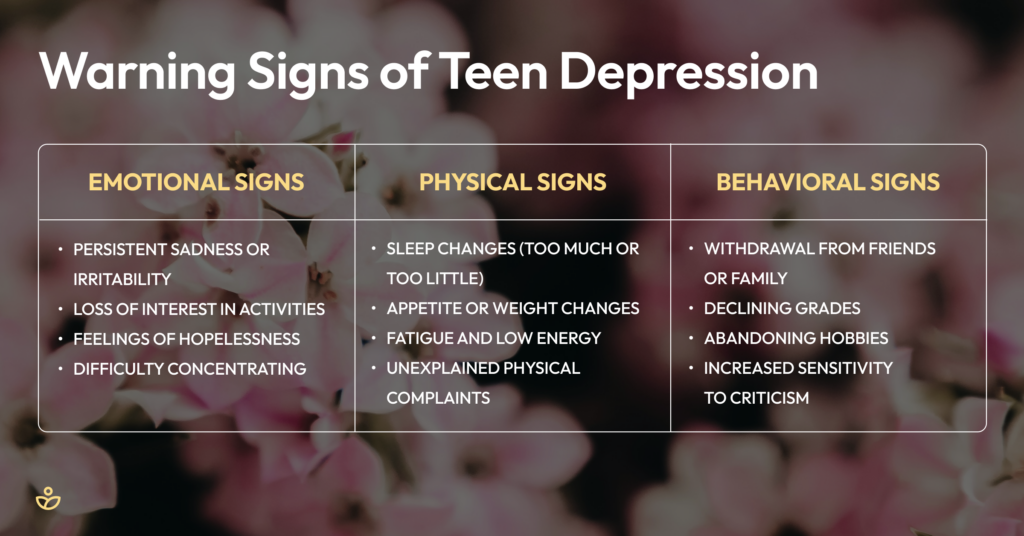
Emotional and behavioral signs:
- Persistent sadness, emptiness, or irritability (yes, depression often looks like anger in teens)
- Loss of interest in activities they once enjoyed
- Withdrawal from family and friends
- Expressions of hopelessness or worthlessness
- Difficulty concentrating or making decisions
Physical and functional changes:
- Significant changes in sleep (sleeping too much or too little)
- Changes in appetite or weight
- Fatigue or loss of energy
- Decline in academic performance
- Physical complaints like headaches or stomachaches with no clear medical cause
The key is functional impairment. Is this affecting their schoolwork, relationships, or daily life? Has it been going on for more than a couple of weeks? That’s when normal adolescent adjustment crosses into depression territory.
How to Talk to a Depressed Teen

When you’re helping a teenager with depression, the way you communicate matters as much as what you say. Depressed teens often feel deeply misunderstood, so your approach needs to prioritize connection over correction.
Start with open-ended questions and genuine curiosity:
- “I’ve noticed you seem really down lately. What’s been going on for you?”
- “You seem to be carrying something heavy. I’m here if you want to talk about it.”
- “I care about you, and I can see you’re struggling. How can I help?”
Validate their feelings without trying to fix them immediately:
- “That sounds really hard.”
- “I hear you. That makes sense that you’d feel that way.”
- “Thank you for telling me. I’m glad you’re letting me in.”
The goal isn’t to have all the answers. It’s to create a safe space where your teen feels heard and accepted, even when they’re in pain.
What Not to Say to a Depressed Teen
Well-meaning parents often say things that accidentally minimize their teen’s experience. Avoid these common phrases:
- “Just think positive” or “Look on the bright side” (Depression isn’t a choice or attitude problem)
- “Other people have it worse” (Comparison doesn’t ease suffering)
- “This is just a phase” (It dismisses real pain)
- “Have you tried just getting out more?” (Oversimplifies a complex condition)
- “You have nothing to be depressed about” (Depression doesn’t require a “good reason”)
These statements, though intended to help, can make your teen feel more alone and less likely to open up to you.
What to Do When Your Teen Is Depressed: What Actually Helps
Supporting a depressed teenager requires sustained effort, not grand gestures. Here’s what makes a real difference:
Be consistently present. You don’t need to force conversations, but show up regularly. Sit in their room for a few minutes. Watch something together without commentary. Let them know you’re available without being intrusive. Consistency builds trust.
Lower the pressure temporarily. If your teen is drowning, adding more expectations won’t help them swim. Work with their school to adjust deadlines if needed. Ease up on non-essential activities. Depression makes everything harder, including basic functioning. Reducing stress where possible gives them space to stabilize.
Support basic structure. Depression disrupts sleep, appetite, and routine. Gently encourage regular sleep and wake times. Make sure nutritious food is available. Sometimes just getting outside for 10 minutes matters. Don’t be rigid, but provide scaffolding when their internal structure has collapsed.
Get professional help. This is not optional. Therapy, particularly cognitive behavioral therapy (CBT) and trauma-informed approaches, has strong evidence for treating teen depression. A skilled therapist gives your teen tools you can’t provide and creates a confidential space where they can process things they might not share with you.Consider psychiatric evaluation when needed. If your teen’s depression is severe, persistent, or includes thoughts of self-harm, a psychiatric evaluation is important. Medication can be a helpful part of treatment for some teens, particularly when combined with therapy.
When Therapy and Medication Aren’t Enough
For some teenagers, standard treatments don’t provide sufficient relief. If your teen has tried therapy and perhaps medication without significant improvement, more advanced evidence-based options exist.
At Anew Therapy in Utah, we specialize in comprehensive mental health care for adolescents and families. Our team offers psychiatric evaluations and medication management specifically tailored for teens, always considering their developmental stage and individual needs.
For treatment-resistant depression, we provide advanced interventions including Transcranial Magnetic Stimulation (TMS), an FDA-approved, non-invasive treatment that uses magnetic pulses to stimulate areas of the brain involved in mood regulation. For older adolescents with severe depression, ketamine therapy may be appropriate under careful medical supervision. Spravato (esketamine) is another FDA-approved option for treatment-resistant depression in adults and, in specific cases, may be considered for older teens when standard treatments haven’t worked.
These treatments are never first-line options, and they require thorough evaluation, parental involvement, and close monitoring. But for families who’ve tried everything else, knowing that additional paths exist can bring hope.
A Reminder to Parents
If you’re reading this, you’re already doing something right. You’re seeking information. You’re taking your teen’s struggle seriously. You care deeply, even when you don’t know what to do.
Many parents carry guilt when their child develops depression, wondering what they did wrong. The truth is that depression is a complex condition influenced by genetics, brain chemistry, stress, trauma, and numerous other factors. It is not caused by imperfect parenting. Your teen needs you to be their advocate and support system, not to blame yourself for their illness.
Also important: you need support too. Parenting a depressed teen is emotionally exhausting. Consider talking to a therapist yourself, joining a parent support group, or leaning on trusted friends. You can’t pour from an empty cup, and taking care of yourself models healthy coping for your teen.
You Don’t Have to Navigate This Alone
Supporting a depressed teenager is one of the hardest things a parent can face, but recovery is possible with the right help. At Anew Therapy, we provide compassionate, evidence-based care for teens and families navigating depression. Our team understands adolescent mental health and works collaboratively with families to create individualized treatment plans that address the whole person.If your teen is struggling, reach out. Schedule a free consultation or call our team at (801) 980-2690 to discuss what your teen needs and what treatment options might help. Depression doesn’t have to define your teen’s story, and you don’t have to figure this out alone. Contact Anew Therapy today to take the first step toward healing.