


When depression has not improved with medication, therapy, lifestyle changes, or other support, doctors may label it treatment-resistant depression (TRD). But treatment-resistant does not mean no hope. It means standard approaches may not fit, and other evidence-based options are worth exploring.
For many patients, that search leads to TMS therapy.
TMS, or transcranial magnetic stimulation, is an FDA-cleared, noninvasive treatment using magnetic pulses to stimulate brain areas involved in mood regulation. It requires no surgery, anesthesia, or sedation and has been used in clinical practice for over 15 years. Research consistently shows meaningful improvement in patients who have not responded to antidepressants, making it a legitimate next step, not a last resort.
Once TMS is on your radar, a practical question follows:
How do you choose the right TMS provider?
If you are looking for TMS therapy in Utah, the answer is not as simple as picking the closest clinic or top search result. The right provider will help you evaluate whether TMS suits your situation, explain what treatment involves, and monitor your progress throughout. This guide covers what to look for and what to watch out for.
1. Look for a clinic that understands treatment-resistant depression
TMS is often considered when depression has not improved with medication, therapy, or other treatments. Your provider should understand not only the technology but also the frustration and uncertainty that come with treatment-resistant depression.
A good TMS provider will take time to learn about your mental health history, past treatments, current symptoms, and your goals. They should be honest about whether TMS is a good fit for you, since not everyone with depression will benefit from it.
When comparing TMS therapy providers in Utah, look for a team that treats the evaluation as an important part of your care, not just a step before starting treatment.
2. Ask who oversees your treatment
TMS might seem simple from the outside. You sit in a chair, a device is placed near your head, and magnetic pulses are given during several appointments. But the planning behind your treatment is important.
Before starting TMS, your provider should explain who will be involved in your care, who reviews your symptoms and history, and who you can talk to if you have questions or concerns. You should also know whether your progress will be monitored and what will happen if your symptoms change.

3. Ask what TMS technology the clinic uses
It is important for a TMS provider to be open about the technology they use.
A good TMS clinic should be able to tell you what system they use, if it is FDA-cleared for your condition, how treatment is mapped, and how the device fits into your care plan.
At Anew Therapy, we use NeuroStar Advanced Therapy, a well-established TMS system with FDA-cleared indications related to major depressive disorder.
Not every clinic needs to use NeuroStar to offer real TMS treatment. There are other FDA-cleared systems. But if a clinic cannot clearly explain what technology they use, what it is cleared for, and how treatment is supervised, it is a good idea to ask more questions.
4. Check reviews, but read them thoughtfully
When comparing TMS providers in Utah, online reviews can help you decide who to trust. Reviews are not a perfect measure of quality, but they can show how patients feel about the clinic.
As a general rule, look for a provider with at least 100 reviews and an average rating of 4.6 stars or higher. A clinic with more reviews may give you more confidence than one with only a few, since it shows a longer pattern of patient feedback.
Still, the number of reviews is not everything. Read the comments, not just the star rating. Look for patterns about kindness, communication, scheduling, insurance help, and whether patients felt respected. In mental health care, how a clinic treats people is important.
5. Compare the things that actually affect your care
When choosing a TMS provider, it helps to compare clinics using the same standards. A nice website or high search ranking does not always show what your real experience will be.
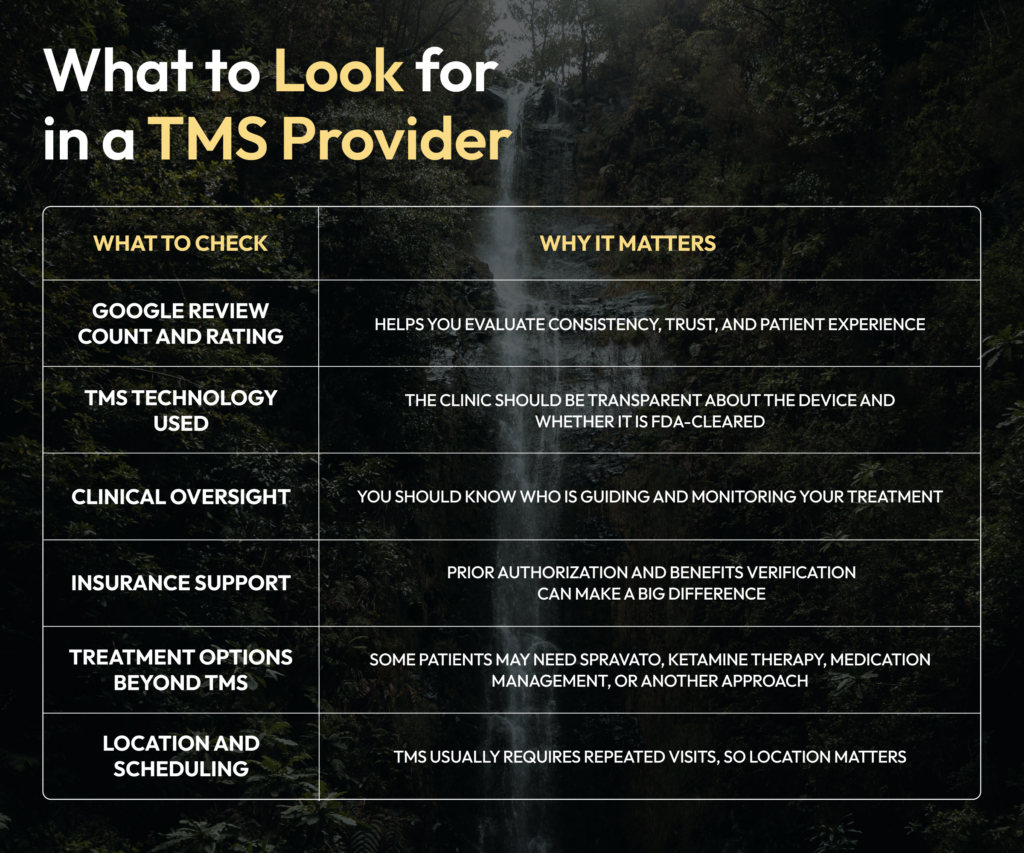
Comparing clinics this way helps you move past just asking, “Which clinic looks best online?” and focus on the more important question: “Which clinic will support me best through the whole treatment process?”
6. Make sure they explain what treatment actually feels like
Many people feel nervous before starting TMS because they are not sure what to expect. A good provider should explain the experience in simple terms.
TMS is usually done in an outpatient setting. You stay awake during treatment, and there is no anesthesia. Many people go back to their normal activities afterward. Your provider should also talk about possible side effects, like scalp discomfort or headache, and explain how they help make treatment as comfortable as possible.
You should not have to guess what will happen at your first appointment, how long sessions take, or how many visits you might need. Clear expectations help reduce anxiety and make it easier to decide if TMS fits your life.
7. Consider location, scheduling, insurance, and treatment options
TMS is not usually a one-time treatment. It often involves a series of sessions over several weeks, so convenience is important.
If you live in Salt Lake City, Sandy, Draper, South Jordan, Provo, Ogden, or another Utah community, consider how realistic the schedule will be. Can you get to appointments regularly? Is parking easy? Does the clinic offer appointment times that fit your life?
Insurance is also important. A good clinic should help you find out if your insurance covers TMS, what paperwork is needed, if prior authorization is required, and what your out-of-pocket costs might be.
It also helps to choose a provider who can talk about different treatment options. Some people may be better suited for TMS, while others might benefit from Spravato, ketamine therapy, medication management, therapy, or a mix of these approaches.
At Anew Therapy, we work with patients who are often tired of starting over. Our goal is to help you understand your options clearly, including TMS, Spravato, and ketamine therapy, so you can make informed decisions about your care.
Questions to ask a TMS provider before starting
Before choosing a TMS clinic, consider asking:
- Am I a good candidate for TMS?
- What TMS system do you use?
- Is the device FDA-cleared for my condition?
- Who oversees my treatment plan?
- How many sessions will I likely need?
- What happens during the first appointment?
- What side effects should I expect?
- Do you help with insurance verification or prior authorization?
- What happens if TMS does not help enough?
- Do you offer other options for treatment-resistant depression?
How a clinic answers these questions can tell you a lot. You should feel informed, respected, and supported, not rushed.
Red flags when choosing a TMS clinic
As you compare TMS therapy providers in Utah, be cautious if a clinic:
- Promises guaranteed results
- Will not clearly explain who oversees care
- Is vague about the TMS technology they use
- Does not discuss whether TMS is actually appropriate for you
- Has very few reviews or a pattern of concerning feedback
- Avoids questions about cost or insurance
- Pressures you to begin before you feel ready
- Does not explain alternatives if TMS is not the right fit
A trustworthy clinic should be confident but not pushy. Hope is important, but honesty matters too.
Finding the right TMS provider in Utah
The best TMS therapy provider in Utah is not just the one with the newest equipment, the nicest website, or the closest office. It is the provider who helps you feel clear about your options, safe during treatment, and supported the whole way.
If you are thinking about TMS for depression, take time to ask questions. Find out what technology is used. Read reviews. Learn about the schedule. Ask about insurance. Notice if the clinic listens to you.
At Anew Therapy, we use NeuroStar Advanced Therapy and focus on a thoughtful, patient-centered approach to treating depression. If you are considering TMS therapy in Utah, we are here to help you determine whether it is the right next step and to explore other options if it is not.
To get started, schedule a free consultation today or call our team at (801) 980-2690.

You do not have to figure this out alone. Depression can make every decision feel harder, but the right care team can help you move forward with clarity, support, and hope. Take it one step at a time.
