If you’ve tried more than one antidepressant and still don’t feel like yourself, you still have options. Two you may hear about are TMS and ECT. Both work directly with the brain, but they’re very different treatments.
At Anew Therapy in Midvale, Utah, we want you to understand every option so you can choose what’s right for you.
For most people with depression, that hasn’t improved with medication, we believe TMS is worth exploring before ECT. It’s gentle, requires no anesthesia, and doesn’t affect memory, so you can keep living your life while you heal. ECT is still the right first choice in some urgent or severe situations, and we’ll always be honest with you when that’s the case.
What Is TMS?
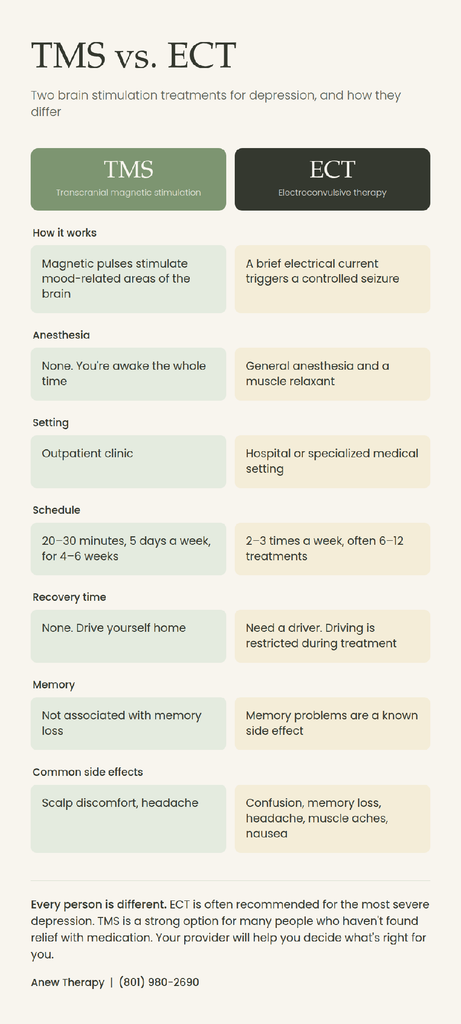
Transcranial magnetic stimulation (TMS) is a non-invasive, FDA-cleared treatment for depression that hasn’t improved with medication. A magnetic coil rests against your head and sends gentle pulses to the part of the brain that helps regulate mood.
You’re awake the whole time. There’s no anesthesia and no recovery time, so you can drive yourself home and get back to your day. Sessions last 20 to 30 minutes, five days a week, for 4 to 6 weeks. At Anew Therapy, we use the NeuroStar Advanced Therapy System.
What Is ECT?
Electroconvulsive therapy (ECT) is one of the most effective treatments for severe depression. It’s done in a hospital or specialized setting under general anesthesia. While you’re asleep, a brief electrical current triggers a short, controlled seizure that can relieve depression, sometimes quickly.
ECT is usually given two to three times a week, often for six to twelve treatments. You’ll need someone to drive you home, and driving is restricted during treatment.
TMS vs. ECT at a Glance
What Are the Risks?
With TMS, the most common side effects are scalp discomfort and mild headaches, which usually fade after the first week. Seizures are rare, occurring in fewer than 0.1% of patients. TMS isn’t safe for people with certain metal implants in or near the head.
With ECT, side effects can include confusion, memory loss, headache, muscle aches, and nausea, plus the risks of anesthesia. Memory often improves in the weeks and months after treatment, though some people notice lasting gaps.
Who Is TMS a Good Fit For?
TMS may be right for you if you’ve tried two or more antidepressants without enough relief, want to avoid anesthesia or memory side effects, or need to keep working and driving during treatment. Many insurance plans cover TMS after several antidepressant trials. Learn about pricing and insurance.
When ECT May Be the Better Choice
ECT generally works more often and faster for the most severe depression. It may be recommended for depression with psychotic symptoms, catatonia, suicidal thoughts that need urgent treatment, or trouble eating and drinking. Anew Therapy doesn’t offer ECT, but if it’s the best option for you, we’ll tell you honestly and help you find the right next step.
Quick Answers
Is TMS the same as shock therapy?
No. “Shock therapy” is an older name for ECT. TMS uses magnetic pulses, and you stay awake.
Does TMS affect memory?
No. TMS isn’t associated with the memory loss that can happen with ECT.
Does TMS hurt?
Most people feel a tapping on the scalp. Any discomfort usually fades within the first week.
We’re Here to Help
You don’t have to figure this out alone. See if you’re eligible for TMS, call Anew Therapy at (801) 980-2690, or schedule a free introductory call.
If you are having thoughts of suicide, please call or text 988 to reach the Suicide & Crisis Lifeline, or call 911 in an emergency.