

If you’re struggling with treatment-resistant depression in Utah and wondering whether your University of Utah Health Plan (UUHP) covers TMS (Transcranial Magnetic Stimulation), the answer is yes for most commercial plan members. TMS is a covered benefit under UUHP’s Individual & Commercial plans when specific clinical criteria are met, making it one of the more accessible insurance-covered options for Utahns with major depressive disorder who haven’t responded to medication alone.
This guide covers everything Utah residents need to know about TMS coverage through University of Utah Health Plans, how Anew Therapy‘s partnership with the Huntsman Mental Health Institute (HMHI) makes UUHP coverage possible at our clinic, and exactly what steps to take to get approved.
What Is TMS Therapy?
Transcranial Magnetic Stimulation (TMS) is a non-invasive, FDA-approved treatment for major depressive disorder (MDD). The FDA approved TMS for depression in 2008, and it has since become one of the most widely covered non-medication treatments for depression across major U.S. insurers.
During a TMS session, a licensed technician places an electromagnetic coil against the patient’s scalp. The coil delivers focused magnetic pulses to the prefrontal cortex, the region of the brain involved in mood regulation. Over a course of treatment, these pulses stimulate underactive nerve cells and help restore healthy neural activity.
A few things that make TMS different from other depression treatments:
- Non-invasive: No surgery, no anesthesia, no needles. Patients sit in a reclined chair and remain fully awake
- No systemic side effects: Unlike antidepressants, TMS does not cause weight gain, sexual dysfunction, nausea, or sedation
- No downtime: Sessions last 20 to 30 minutes and patients can drive themselves and return to normal activities immediately after
- Strong success rate: TMS is effective for approximately 50 to 60% of patients with treatment-resistant depression
TMS is also FDA-cleared for obsessive-compulsive disorder (OCD). The Huntsman Mental Health Institute at the University of Utah is one of the highest-volume TMS programs in the Mountain West region, providing more than 3,500 TMS treatments annually.
University of Utah Health Plans: An Overview
University of Utah Health Plans (UUHP) operates as part of the University of Utah Health system, the only academic medical center in the state of Utah. UUHP offers several plan types relevant to Utah residents:
- UUHP Individual & Commercial Plans – For individuals and employer groups across the Wasatch Front and broader Utah market. Anew Therapy is in-network for these plans.
- Healthy U (Medicaid) – Utah’s Medicaid managed care plan for eligible low-income residents. Coverage and provider availability vary by Medicaid type. See below for more information.
- Healthy U CHIP – Children’s Health Insurance Program coverage for qualifying children and families. Call member services on the back of your card to confirm TMS provider availability.
Each plan has its own TMS prior authorization criteria and provider network. Understanding which plan you’re on is the essential first step.
Does University of Utah Health Plan Cover TMS?
UUHP Individual & Commercial Plans
Yes. UUHP covers TMS therapy for commercial plan members when all clinical criteria are met and prior authorization is obtained. Anew Therapy is in-network for UUHP Individual & Commercial plans through our partnership with the Huntsman Mental Health Institute, and we can help coordinate your prior authorization from start to finish.
Healthy U (Medicaid)
Coverage depends on which type of Healthy U Medicaid plan you have. According to UUHP’s published TMS policy (MP-001):
- Healthy U Integrated Medicaid: Eligible for TMS coverage under the same criteria as commercial plans
- Healthy U Traditional/Legacy Medicaid: TMS is not covered, as major depressive disorder is a carved-out behavioral health condition for this plan type
If you are on a Healthy U Medicaid plan, we recommend calling the member services number on the back of your insurance card to confirm your specific Medicaid type and locate an in-network TMS provider for your plan.
Healthy U CHIP
TMS coverage under Healthy U CHIP varies. Provider availability and coverage criteria are best confirmed by calling the member services number on the back of your card.
Criteria for TMS Coverage Under University of Utah Health Plans
Per UUHP’s published medical policy (MP-001, effective February 2025), all of the following criteria must be met for initial TMS coverage under commercial plans:
1. Age Requirement
Patient must be 18 years of age or older.
2. Confirmed MDD Diagnosis
A diagnosis of major depressive disorder without psychosis, confirmed by a licensed psychiatrist or psychiatric APRN using DSM-5 criteria, is required.
3. Psychiatric Supervision
Treatment must be provided by or under the direct supervision of a licensed psychiatrist or Psychiatric Advanced Practice Registered Nurse (APRN). Through our partnership with HMHI, Anew Therapy meets this requirement and provides psychiatric oversight throughout your TMS course.
4. FDA-Approved TMS Device
The TMS device used must be FDA-approved. Anew Therapy uses FDA-cleared TMS equipment.
5. Documented Medication Failures
You must demonstrate failure of antidepressant therapy, defined by one of the following:
- Documented failure of at least 2 antidepressant trials at therapeutic dose and duration (more than 6 weeks each) from two different medication classes in the current episode
- Written documentation of an inability to tolerate antidepressant agents, evidenced by four or more lifetime trials with distinctive side effects
6. No Contraindications
Patients must not have contraindications to TMS, including seizure disorders, cochlear implants, ferromagnetic metal implants near the head, certain neurological conditions, acute suicidal ideation, active psychotic symptoms, or high alcohol or illicit drug use within the last 30 days.
7. Prior Authorization
Prior authorization is required before TMS treatment begins. Your provider must submit clinical documentation, diagnosis confirmation, and medication history to the plan. If our providers think you are a good candidate for TMS, Anew Therapy will handle the prior authorization process on your behalf.
Session limit: UUHP approves a maximum of 36 TMS sessions within an 8-week period for initial coverage. Repeat coverage is available for patients who had a positive prior response, provided it has been more than 6 months since previous treatment.
Why the HMHI Partnership Matters for Your TMS Coverage
The Huntsman Mental Health Institute (HMHI) at the University of Utah is Utah’s leading institution for neurostimulation treatment and research. HMHI is part of the National Network of Depression Centers and is among the highest-volume TMS programs in the Mountain West, administering more than 3,500 TMS treatments per year.
Anew Therapy’s partnership with HMHI is the key reason we are able to accept University of Utah Health Plans, including most commercial UUHP plans, for TMS treatment. Rather than navigating a large academic hospital system, this partnership allows Anew to offer the same insurance access in a more personalized, accessible clinical setting.
In other words: you get the credibility and insurance reach of the HMHI/University of Utah Health network, delivered through the individualized care experience that Anew Therapy is built around.
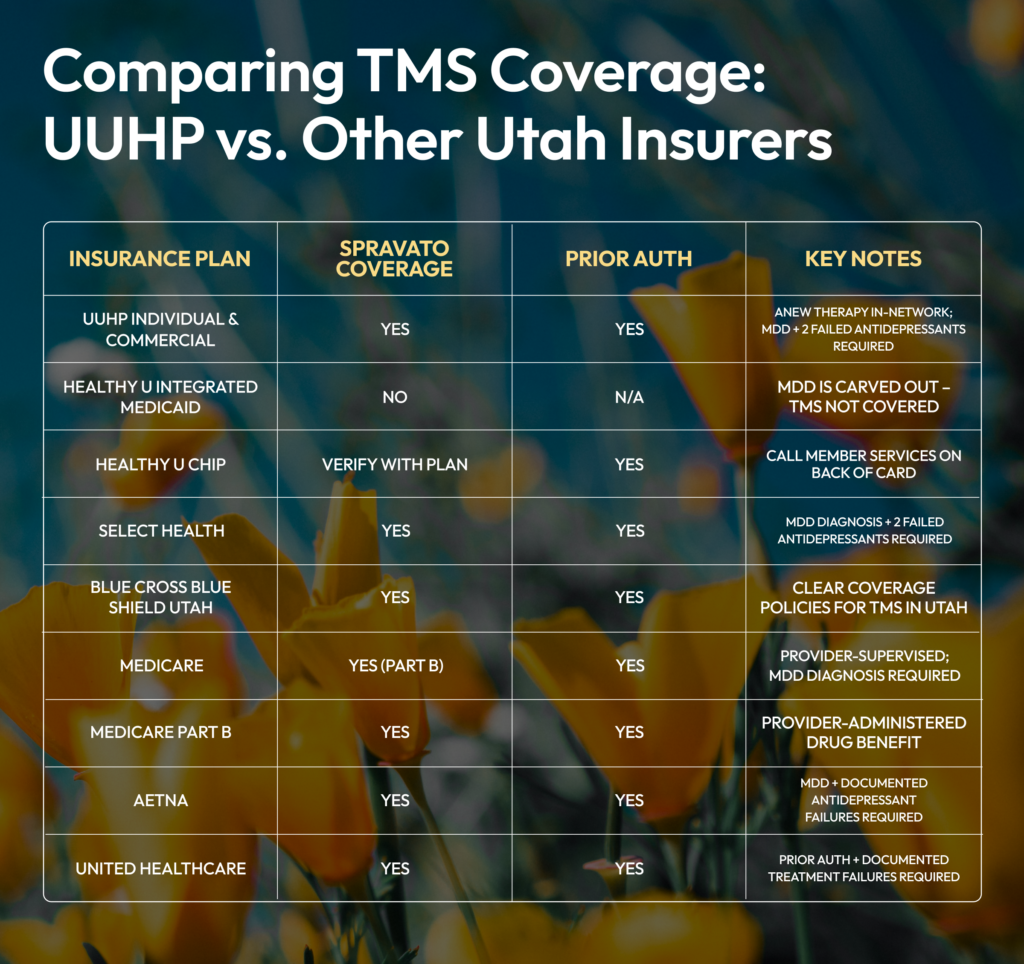
Comparing TMS Coverage: UUHP vs. Other Utah Insurers
Ready to Start TMS Treatment in Utah?
If you’re a University of Utah Health Plan member ready to explore TMS, Anew Therapy is an in-network TMS provider serving patients across the Wasatch Front. We accept most major Utah insurance plans, including UUHP, thanks to our partnership with HMHI.
At Anew Therapy, we understand that getting to treatment is half the battle. Our team specializes in navigating the prior authorization process, so you don’t have to figure it out alone. Here’s what sets us apart:
- HMHI-Partnered: Our partnership with the Huntsman Mental Health Institute is what makes University of Utah Health Plan coverage possible at our clinic
- In-Network for UUHP Commercial: We accept most UUHP Individual & Commercial plans and handle prior authorization on your behalf
- FDA-Cleared Equipment: We use FDA-approved TMS devices for safe, evidence-based treatment
- Holistic Approach: We also offer Spravato (esketamine) and IM ketamine therapy, so if TMS isn’t the right fit, we have other covered and effective options to explore
- Personalized Care: Every patient receives a thorough evaluation and a treatment plan built around their unique clinical history, needs, and schedule
Whether you’re just starting to research TMS or you’ve already been denied coverage elsewhere, our team can help you understand your options and advocate for the treatment you deserve.
Just Schedule a free consultation today or call our team at (801) 980-2690.

Frequently Asked Questions (FAQ)
Does the University of Utah Health Plan cover TMS?
Yes, for UUHP Individual & Commercial plan members who meet medical necessity criteria and obtain prior authorization. Healthy U Integrated Medicaid members are also eligible under the same criteria. Healthy U Traditional/Legacy Medicaid does not cover TMS. If you are on a Healthy U plan, call the number on the back of your insurance card to confirm your coverage.
How many TMS sessions does UUHP cover?
UUHP covers a maximum of 36 TMS sessions within an 8-week period for initial treatment. Repeat coverage is available for patients who had a positive prior response, provided it has been at least 6 months since their previous treatment course.
How many antidepressants do I need to have tried before UUHP will cover TMS?
UUHP requires documented failure of at least 2 antidepressants from two different medication classes, each at therapeutic dose for more than 6 weeks, in the current depressive episode. Alternatively, documented intolerance to antidepressants across four or more lifetime trials may also qualify.
Can I drive myself to and from TMS sessions?
Yes. Unlike Spravato or ketamine, TMS does not cause sedation or dissociation. You can drive yourself to and from appointments and return to work or normal activities immediately after each session.
What if UUHP denies my TMS prior authorization?
A denial is not necessarily final. You and your provider can file a formal appeal with additional clinical documentation and a detailed letter of medical necessity. Many initial denials are successfully overturned on appeal. Anew Therapy’s team has experience navigating the prior authorization and appeals process and can support you every step of the way.
How long do TMS results last?
Many patients experience lasting improvement well beyond the initial treatment course. Studies suggest TMS results can persist for a year or more in patients who respond well. For patients whose depression returns, UUHP allows repeat TMS coverage provided it has been more than 6 months since the previous course and the patient had a documented positive response.
Is TMS better than Spravato or ketamine for treatment-resistant depression?
TMS, Spravato, and ketamine therapy all have strong evidence bases for treatment-resistant depression but work differently and suit different patients. TMS is gradual and cumulative, with results typically emerging over 4 to 6 weeks. Spravato and ketamine can provide rapid relief, sometimes within hours. At Anew Therapy, we offer all three options and will work with you to determine which treatment, or combination, is the best clinical and financial fit.
Are you a University of Utah faculty or staff member wondering what mental health treatments are covered by your University of Utah Health Plan? Anew Therapy now accepts HMHI coverage and offers therapy, TMS, and ketamine-assisted treatment in Utah. Schedule a free consultation today.
