
Most people who find Anew Therapy have already done their homework. They have read the studies. They have searched for TMS therapy success stories late at night. They have skimmed through TMS therapy patient reviews trying to figure out what is real and what is marketing.
Underneath all of that research is usually one simple question:
Does this actually work, and what does TMS therapy feel like?
The clinical data matters. The research behind TMS is solid. But when you are the one living with depression that has not fully responded to medication, statistics only go so far. What tends to matter more are real stories from people who were in that in-between place. Not in crisis. Not okay either.
Here are three of them. A musician, a Navy veteran, and an architect, all with different lives but a shared experience: medication had stopped being enough.
When What Used to Work Stops Working
Kelly is a professional violinist in Nashville. She was diagnosed with depression in middle school and spent years trying different medications and combinations.
“The medications I had tried all had really bad side effects or they would do absolutely nothing, which was just as discouraging as the side effects.”
What she describes is not dramatic sadness. It is something quieter and harder to explain.

That emotional numbness is something we hear often. On the outside, life may look functional. Inside, it feels flat.
Carol’s experience was different. Her medications had worked well for years.
“I’ve had great success with a lot of the medicines, but they weren’t working anymore.”
Over time, she found herself struggling to function at work and at home.
“It was like the sun wasn’t shining. It was gray, cloudy.”
Bart, a Navy veteran and retired police officer, was still on medication when he came in. He was steady. He was working. But he knew he was not where he wanted to be.
“I wasn’t getting the full effects of the medication.”
That middle space can often be the hardest place to sit. You are not falling apart, but you aren’t fully living either.
What TMS Therapy Actually Feels Like
When people ask what TMS therapy feels like, they usually mean two things. What is the treatment physically like? And what does it feel like when it starts to work?
Physically, TMS is straightforward. You sit in a chair while a magnetic coil delivers focused pulses to an area of the brain involved in mood regulation. There is no anesthesia. No sedation. No systemic medication side effects. Sessions last around 20 minutes. Most people return to work or daily activities right after.
The emotional shift is more personal, which is why TMS therapy patient reviews can sound so different from one another.
Kelly remembers one specific morning during her course of treatment.
“There was absolutely one day that I woke up and walked outside and it was as if the sky was bluer.”
She describes it this way:
“It’s almost as if I had been going through life with this dimmer switch, and all of a sudden everything was so clear.”
For Bart, the change was simpler.
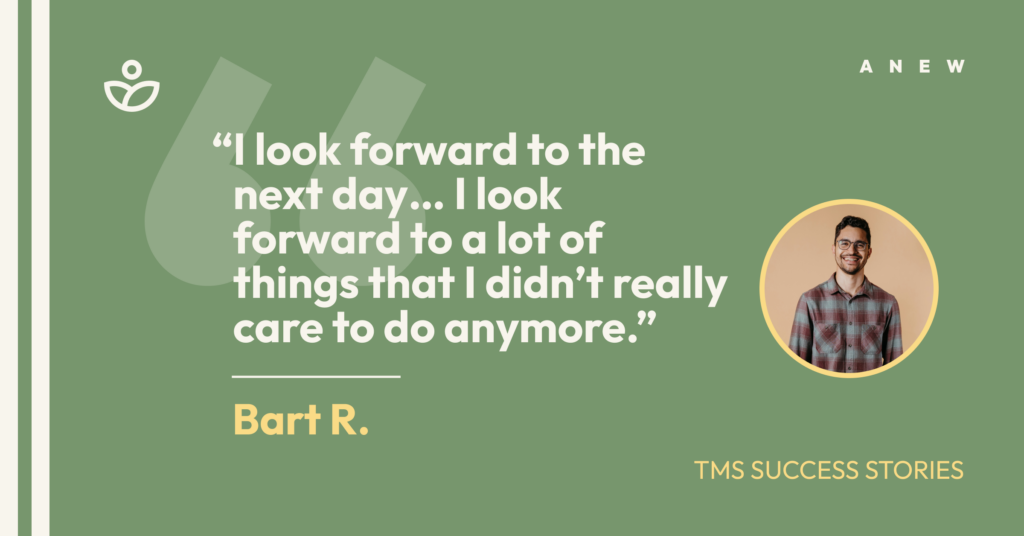
That return of anticipation can feel small on paper. In real life, it is everything.
Carol’s improvement was gradual.
“There were days when the sun was shining and then there were more days when the sun was shining.”
She noticed she was more engaged at work. More present with her husband. She had the energy to call friends again.
“Instead of working on eight cylinders, I was working on one or two.”
After treatment, she felt like she had her full capacity back. Not like she was a different person, just herself again.
It Is Not Always Immediate
Some TMS therapy success stories can make it sound instant. That is not always how it happens.
Kelly is clear about her experience:
“In my case it didn’t work right away, so I had to keep plugging forward and keep going to treatments, and it eventually worked for me.”
TMS therapy is typically delivered over several weeks (usually around six) with sessions most weekdays. Some people notice subtle changes in sleep or concentration before the mood itself starts to shift. The emotional lift, when it comes, tends to build rather than arrive all at once. For some people it’s gradual enough that they almost don’t notice until they realize they’ve had a good week, and then another one.
Getting Back to Yourself
Across many TMS therapy success stories, the most meaningful outcome is not just reduced symptoms. It is the return of identity.
Kelly began to see creative possibilities in her music career that had felt out of reach.
Bart shares his experience openly because he wants other veterans and first responders to know there are options.
And Carol ends her story by describing who she is:
“I’m an architect, I’m a newlywed, I’m a sailor… and I’m no longer suffering from depression.”
That shift from depression as the defining, organizing fact of your life to something that belongs in the past tense is what our team hears about most from people after a successful course of treatment.
Considering TMS in Utah
At Anew Therapy in Sandy, Utah, we offer NeuroStar TMS therapy as part of a comprehensive, individualized treatment approach. TMS is not presented as a miracle cure or a last resort. It is one evidence-based option that often works well alongside therapy, lifestyle changes, and other support.
If medication has stopped working the way it used to, or if you feel stuck in that gray middle space, we are here to have an honest conversation about whether TMS could help.
You do not have to stay in the gray.Reach out to schedule a consultation with our team, either by scheduling online or calling/texting our team at (801) 980-2690. We will walk you through what to expect, answer your questions directly, and help you decide on the right next step.