

There is a moment many women describe in their late 30s or 40s when something starts to feel different. Sleep gets lighter, patience gets shorter, anxiety shows up out of nowhere. The same workload suddenly feels heavier, and relationships feel harder to manage. You may still be functioning, but you do not quite feel like yourself.
For many women, that shift gets mislabeled as burnout, stress, aging, or “just needing to push through.” But according to Dr. Mallorie Cracroft, OB/GYN and founder of Uplift for Her, hormones may be a major part of the picture.
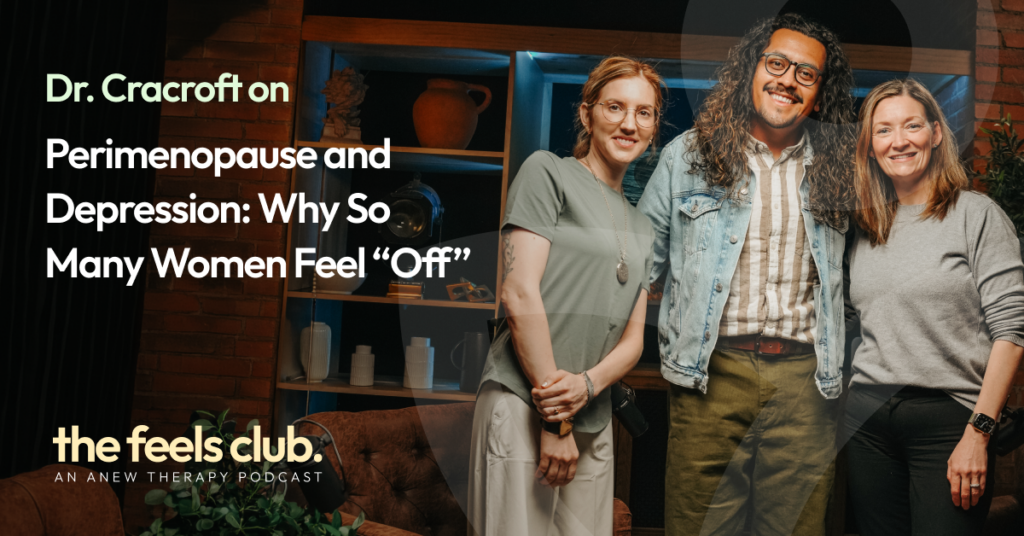
On a recent episode of The Feels Club: An Anew Therapy Podcast, Dr. Cracroft joined Anew Therapy to talk about the connection between perimenopause, mood changes, anxiety, and depression. Her message was clear: relief is possible, and women deserve better answers.
What Is Perimenopause?
Perimenopause is the transition leading up to menopause, when hormone levels begin to shift before periods stop completely. It often starts earlier than people expect, sometimes in the late 30s or early 40s, and can last for several years.
Dr. Cracroft describes it simply:
“I kind of think of it as the second puberty. You have the first puberty where you go from no periods to periods, and then you have the second puberty where you go from periods to no periods.”
That comparison fits. Just as puberty can bring emotional and physical changes, perimenopause can do the same, only in a different direction.
The challenge is that many women know menopause exists, but few are prepared for the transition that can come before it.

Why Mood Changes Often Show Up First
Hormones do much more than regulate the menstrual cycle. Estrogen and progesterone also influence sleep, stress response, emotional regulation, and brain chemicals tied to mood.
As progesterone begins to decline, many women notice anxiety, irritability, and disrupted sleep. Later, changing estrogen levels can bring lower mood, fatigue, brain fog, and a heavier emotional baseline.
For women who have never dealt with anxiety or depression before, this can feel especially disorienting.
Signs It Might Be Perimenopause, Not Just Stress
Because perimenopause overlaps with busy adult life, it often gets mistaken for ordinary stress. A few signs can suggest hormones may be part of the picture:
- New anxiety in your late 30s or 40s
- Feeling fine one week, then unlike yourself the next
- Irritability that feels out of proportion
- Waking during the night and struggling to fall back asleep
- Mood dips tied to your cycle
- Trouble focusing or feeling mentally scattered
- Feeling less resilient than you used to
None of these automatically mean perimenopause, but they are worth paying attention to.
Why It Gets Missed
These years are often full. Careers become more demanding. Kids need more support in different ways. Parents may begin aging. Relationships change. Sleep becomes less reliable. Many women are carrying more responsibility than ever.
Then hormone fluctuations begin at the same time.
That combination can look like burnout because everything feels harder. It can look like ADHD because concentration drops. It can look like depression because motivation disappears.
Sometimes it is one thing. Often it is several things at once.
That is why a thoughtful evaluation matters. If hormones are ignored entirely, an important part of the picture can be missed.
What to Track for 30 Days
If you suspect hormones are affecting your mental health, keep notes for one full cycle. Focus less on perfect data and more on patterns. When does anxiety spike? When do you sleep poorly? When do you feel like yourself again?
Even simple notes in your phone about mood, sleep, irritability, and cycle timing can help a provider connect dots that are easy to miss from memory alone.
What Can Help
Treatment depends on the person, but there are real options.
Some women benefit from hormone-informed medical care such as progesterone support or hormone therapy under a qualified provider. Others need support for anxiety or depression directly through therapy or medication management.
Therapy can be especially valuable during this season because perimenopause often arrives alongside major life pressures. Even when hormones are part of the cause, stress, grief, parenting strain, relationship conflict, and identity changes still need care.
Lifestyle habits also matter more than they once did. Many women notice they can no longer power through chronic stress, poor sleep, under-eating, overworking, or nonstop caretaking the same way they did years earlier.
For women dealing with persistent depression or feeling deeply stuck, ketamine-assisted therapy may also be an option when clinically appropriate.
This Stage Is Not the End of You
There is a lot of fear-based messaging around perimenopause. Many women absorb the idea that after 40, everything declines and suffering is just part of the deal. Dr. Cracroft pushed back on that directly. She does not buy into the narrative that once perimenopause starts, life is simply downhill from there.
“I don’t like that narrative, this idea that once we hit perimenopause, life sucks. I don’t like that conversation. I’m an optimist. I want to be happy. I want people to know how to support their bodies. And we can, but it does take a little more proactivity.”
For many women, this stage is not about losing themselves. It is about becoming clearer. Clearer on what they need, what they value, and what they no longer have the capacity to carry. That kind of growth can happen alongside very real symptoms that need support. Both can be true at the same time.
It is also worth saying that you do not need to wait until things feel unmanageable to get help. If mood changes are affecting your sleep, relationships, work, parenting, or general quality of life, that is enough reason to reach out.
Support Is Available at Anew Therapy
If perimenopause has brought anxiety, depression, emotional exhaustion, relationship strain, or the feeling that you are not yourself anymore, support is available.
Anew Therapy helps women navigate mood changes, burnout, anxiety, depression, trauma, and life transitions with personalized mental health care. Depending on your needs, support may include therapy, medication management, or ketamine-assisted treatment.
Schedule a free consultation today or call Anew Therapy’s team to talk through your options. Sometimes the first step is simply understanding what is happening and realizing you do not have to carry it alone.

If you need immediate support, call or text 988 for the Suicide & Crisis Lifeline.
