

If you’ve landed here, you’re probably past the point of wanting a glossy surface-level overview of ketamine- assisted psychotherapy (KAP). You want to know what it actually is, what the process looks like, and whether the evidence behind it is solid. That’s exactly what this guide is for.
For those that would still like to start with the nutshell version: KAP pairs a carefully supervised ketamine session with structured therapy before, during, and after dosing. Ketamine can create a window where the brain becomes more receptive and less locked into familiar patterns. Therapy is what makes that window useful. Together, the combination of therapy and ketamine give patients something most have been looking for: a real chance at relief that doesn’t just wear off.
Now let’s get to the real science behind it all.
How Ketamine Works in the Brain
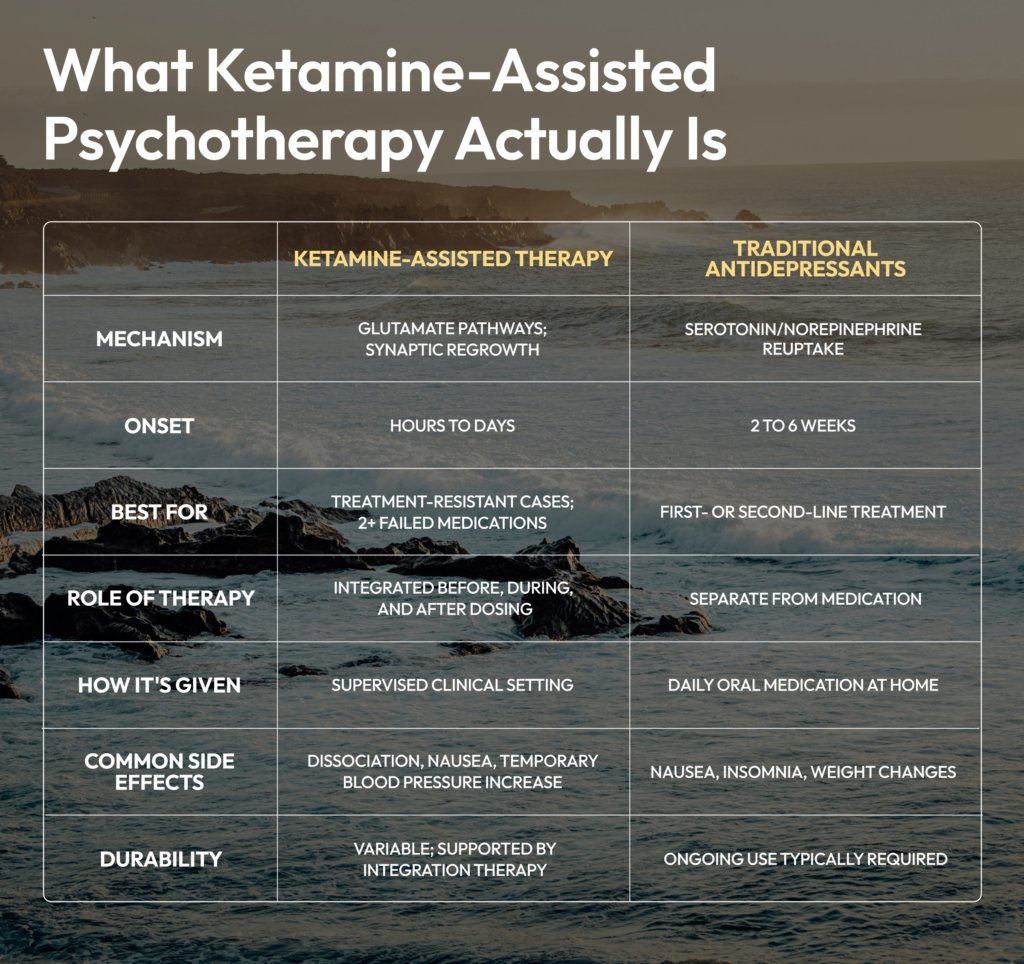
Traditional antidepressants work primarily on serotonin reuptake and typically take two to six weeks to build noticeable effects. Ketamine operates on a different system entirely. According to the National Institute of Mental Health, ketamine’s antidepressant action involves glutamate-related pathways and changes in synaptic connections, which explains why some patients report relief within hours or days rather than weeks.
What this produces, clinically, is a temporary period of increased neuroplasticity. Thoughts and emotional responses that normally run on autopilot can feel less fixed. Patients sometimes describe it as “having a bit more distance” from long-standing beliefs about themselves or their circumstances. That distance is not the goal in itself, but therapy uses that window to do work that would be harder or impossible outside of it.
What Ketamine-Assisted Psychotherapy Actually Is
KAP isn’t just a ketamine injection session with a therapist added to the waiting room. It’s a specific treatment model in which the psychotherapy component is designed to complement the pharmacological effects of ketamine at each stage of treatment.
A standard KAP protocol includes a medical and psychiatric evaluation, one or more preparation sessions, a supervised dosing session, and integration therapy afterward. Each of those stages has a distinct purpose, and skipping any of them tends to produce worse outcomes. Research and clinical literature consistently describe the psychotherapy component as central, not supplementary.
The Treatment Process, Step by Step
1. Evaluation and Screening
A thorough evaluation comes before anything else. Providers assess psychiatric history, medical factors (particularly cardiovascular health), current medications, substance use history, and overall candidacy for this level of care. Published guidelines are clear that careful screening and informed consent are prerequisites, not formalities. Ketamine is not appropriate for everyone, and a good clinic will tell you that directly.
2. Preparation Sessions
This is often the most underestimated part of the process. Before any dosing occurs, the therapist works with the patient to set realistic expectations, identify what they are hoping to address, and establish enough therapeutic rapport to feel grounded during the session. Patients who go in expecting a dramatic revelation on every visit can find the experience confusing when it is more subtle. Preparation shifts the focus toward something more useful: staying open, observing what arises, and trusting the process without forcing it.
3. The Ketamine Session
Depending on the clinic and the patient, ketamine may be administered by IV infusion, intramuscular injection, or as intranasal esketamine. Spravato is the FDA-approved nasal form of esketamine and must be given in a certified medical setting under specific safety protocols. Racemic ketamine used in other KAP protocols is typically prescribed off-label, which makes careful clinical standards especially important when choosing a provider.
During the session, patients commonly report altered perception, a loosening of their usual thought patterns, or a floating, spacious quality to the experience. Dissociation can occur and is generally short-lived in a monitored clinical setting. Blood pressure monitoring is standard because ketamine can cause transient increases.
4. Recovery and Post-Session Observation
Patients are monitored after dosing until the acute effects have resolved. Driving is not permitted on the day of treatment, and major decisions should wait. This is standard practice, not an afterthought.
5. Integration Therapy
Integration is where the clinical value of KAP either compounds or fades. The session may have surfaced something significant. A patient might recognize a pattern they have been living inside for years, reconnect with grief they have been avoiding, or simply notice that their internal monologue has shifted. Integration therapy helps translate those observations into something actionable. The insights are the starting point, not the endpoint.
Who Is a Candidate for Ketamine-Assisted Psychotherapy?

The strongest evidence base for ketamine centers on treatment-resistant depression, which generally means major depressive disorder that has not responded adequately to at least two antidepressant medications. There is also growing clinical interest in PTSD, severe anxiety, and trauma-related presentations, though the research is less uniform across those conditions.
KAP is not usually a first-line treatment. It tends to be most appropriate when other approaches have not produced meaningful improvement, when symptoms are severe enough to warrant a more intensive intervention, or when a patient needs more neurological flexibility to engage productively in therapy. Those are clinical judgments that require an actual evaluation.
What the Experience Is Actually Like
People want the honest version, so here it is. Some sessions feel calm, spacious, and clarifying. Others feel unusual or emotionally intense. Time may feel slower. Familiar thoughts may arrive in a less defended way. Some Anew Therapy patients describe it as genuinely revelatory. Others describe it as strange but ultimately useful.
What tends to matter most is not the content of the session itself but the setting: a clinician who is skilled and present, a physical environment that feels safe, clear expectations going in, and solid support on the other side of it. That is not incidental to the treatment. It is part of why a structured, therapy-supported model produces better outcomes than the injection alone.
A Few Things Worth Knowing Before You Start
Ketamine is a dissociative anesthetic, and the risks associated with it deserve straightforward discussion. Common short-term side effects include sedation, nausea, dizziness, and temporary increases in blood pressure. Dissociation is expected to some degree and is manageable in a supervised clinical setting.
The FDA has raised concerns about compounded ketamine products being prescribed outside of appropriate medical oversight, particularly through services that involve minimal screening or remote administration. Those concerns are legitimate. The question to ask of any clinic is not just whether they offer KAP but how they offer it. What does their screening process look like? How is the session monitored? What does follow-up care involve?
The structural quality of the treatment matters as much as the medication itself.
Why Anew Therapy
If you are in Utah and looking for a provider who treats ketamine-assisted psychotherapy as a clinical service rather than a product, consider reaching out to our team at Anew Therapy. Anew offers ketamine-assisted psychotherapy, Spravato, and TMS from its Midvale location, and the approach is built around integrated care rather than standalone ketamine sessions.
That matters because not every patient who comes in for ketamine is actually the best candidate for KAP. Some may be better served by Spravato. Others may benefit more from TMS or a combined treatment plan. Anew’s service range allows for that kind of individualized assessment rather than fitting every patient into the same protocol, and our team is trained with safety and compassion as top priorities.
If you have been through standard treatment options without finding relief, KAP may be for you. Schedule a free consultation or call our team at (801) 980-2690 to get started.
Frequently Asked Questions
What is ketamine-assisted psychotherapy?
KAP is a treatment model that pairs ketamine with structured psychotherapy at each stage of the process. The goal is not just temporary symptom relief but deeper emotional processing that patients can build on after treatment ends.
How does ketamine work differently from antidepressants?
Standard antidepressants primarily target serotonin and take weeks to produce noticeable effects. Ketamine works on glutamate pathways and synaptic connections, which is associated with rapid changes in mood and neuroplasticity. That difference in mechanism is part of why ketamine has drawn clinical interest for patients who have not responded to traditional medications.
Is ketamine psychotherapy the same as Spravato?
No. Spravato is the FDA-approved nasal form of esketamine and must be administered in a certified medical setting under specific safety protocols. Ketamine-assisted psychotherapy typically refers to a broader treatment model that may use off-label racemic ketamine combined with structured therapy. The two are related but distinct.
How many sessions are usually needed?
Protocols vary considerably depending on the clinic, the condition being treated, and how the patient responds. There is no universal answer, which is one reason a thorough evaluation matters before starting. The number of sessions should follow clinical need, not a predetermined package.
Is it safe?
When delivered in an appropriate clinical setting with proper screening, monitoring, and follow-up care, KAP can be conducted safely. The most significant risks arise when those safeguards are absent. Blood pressure monitoring, qualified staff, and structured follow-up are not optional components.
Looking for the best ketamine-assisted psychotherapy clinic in Utah? Anew Therapy offers KAP, TMS, and Spravato treatment with compassionate, individualized care. Schedule a free consultation today.
